Under Support at Home (SaH), you may contribute towards some services and the government pays the rest. Clinical services such as nursing, allied health and personal care have no participant contribution. For other services, your contribution depends on the type of service, your pension or income status and the price your provider sets. Lifetime caps limit what eligible people can pay for non-clinical services over time.
Key Takeaways
- Clinical services, including nursing, allied health and personal care, have a 0% participant contribution.
- Independence supports attract lower contributions than everyday living services, such as cleaning, meals and gardening.
- Your contribution rate depends on pension status and, where relevant, an income and assets assessment.
- Providers set service prices, so the same contribution percentage can produce different out-of-pocket costs.
- Lifetime caps apply to non-clinical contributions, after which the government funds eligible approved services. Current cap amounts are on our Schedule of Fees and Charges page.


What is a Support at Home Contribution?
A Support at Home contribution is the portion of the cost of certain approved home care services that you pay yourself. The government pays the rest. Contributions apply to non-clinical services, such as independence and everyday living supports, and are calculated as a percentage of the service price. The percentage depends on:
- the type of support you receive
- your pension and income status
- the outcome of any income and assets assessment.
There is a lifetime cap on what you can be asked to contribute towards non-clinical services. Once it’s reached, the government covers the full cost of approved non-clinical services. Grandfathered participants protected by the “no worse off” principle have a lower cap. The current cap amounts are on our Schedule of Fees and Charges page, and you can read more about how the lifetime cap works.
What is the Non-Clinical Care Contribution Under Support at Home?
Non-clinical care refers to everyday support services that help a person manage daily life at home, rather than medical or health treatment. Under Support at Home, non-clinical care generally falls within the Independence and Everyday Living service categories. The government fully funds all approved clinical care services, including nursing, allied health and, since 1 October 2026, personal care such as help with showering and dressing.
Independence supports can include mobility support, transport and social support. Everyday living supports include cleaning, laundry, meal preparation, shopping and gardening. The purpose of non-clinical care is to support day-to-day living, reduce isolation and help people stay independent at home for as long as possible.
How Are Support at Home Contribution Rates Determined?
Your pension status determines your Support at Home contribution rate. Part pensioners and self-funded retirees who hold a Commonwealth Seniors Health Card (CSHC) also complete an income and assets assessment, which sets where they sit within the range.
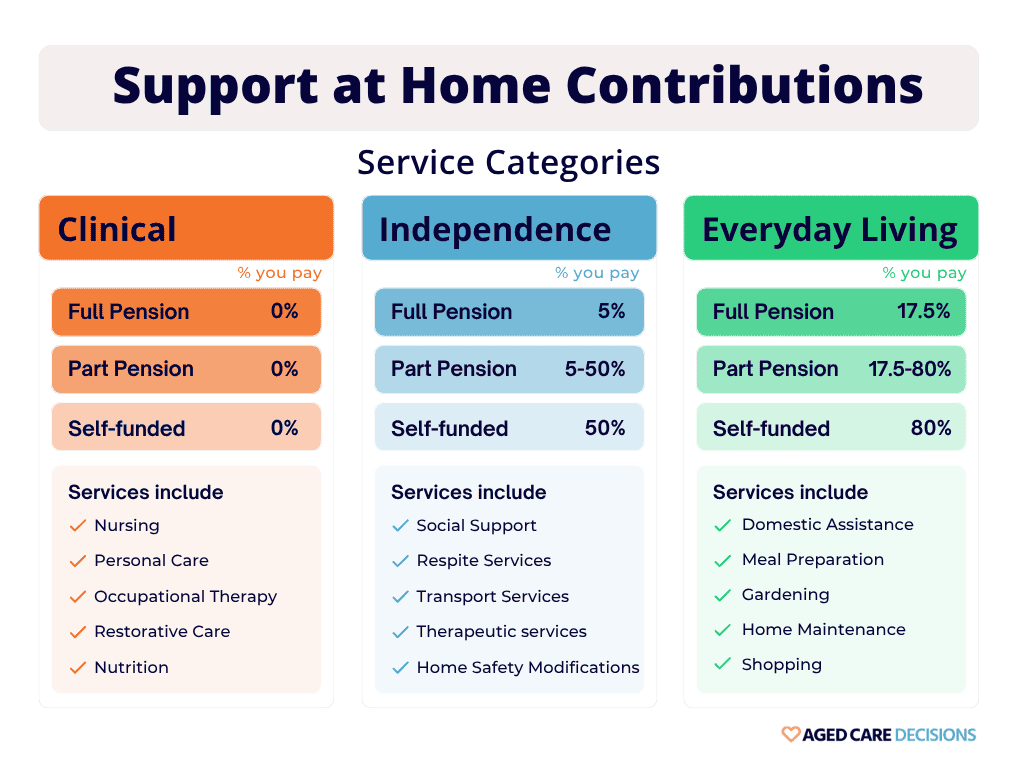
Full Pensioner Contributions Under Support at Home
If you’re a full pensioner, you will never be asked to pay more than you can afford and you don’t complete an income and assets assesment.
| ❌ Daily care fee | There is no daily care fee payable |
| ❌ Income tested fee | As a full pensioner you won’t be means-tested and will not pay income-tested fees |
| ❌ Clinical supports | Nursing, allied health and personal care are fully funded |
| ✅ Independence supports | You will pay a 5% contribution towards the cost of independence support services. This can include mobility support and transport. For example, if a home care worker assists you with transport for 2 hours per week at $50 per hour, you will pay $5 and Support at Home will pay the remaining $95 |
| ✅ Everyday Living supports | You will pay a 17.5% contribution towards the cost of daily living supports. This can include house cleaning, laundry, meal preparation and meal delivery services, gardening, and social supports. For example, if you receive home delivered meals for $200 per week, you will pay $35 and Support at Home will pay the remaining $165. |
Part Pensioner Contributions Under Support at Home
If you’re a part pensioner, you must complete an income and assets assessment. The result sets your contribution rate within the range below.
| ❌ Daily care fee | There is no daily care fee payable |
| ✅ Income tested fee | As a part pensioner, you may be required to pay an income-tested care fee, depending on your assessable assets and income. |
| ❌ Clinical supports | All clinical support services, such as nursing care, medical supplies, personal care and allied health services, are fully covered by the government. |
| ✅ Independence supports | You will pay between 5%-50% as a contribution towards the cost of independence support services. This can include mobility support and transport. For example, if a care worker assists you with daily mobility support at a cost of $400 per week, you will pay between $20-$200 and Support at Home will pay the balance. |
| ✅ Daily living supports | You will pay between 17.5%-80% as a contribution towards the cost of daily living supports. This can include house cleaning, laundry, meal preparation and meal delivery services, gardening, and social supports. For example, if you receive a cleaning service at a cost of $200 per week, you will pay between $35-$160, and Support at Home will pay the balance. |

Full Pensioner Contributions Under Support at Home
If you’re a full pensioner, you will never be asked to pay more than you can afford and you don’t complete an income and assets assesment.
❌ Daily care fee | There is no daily care fee payable |
❌ Income tested fee | As a full pensioner you won’t be means-tested and will not pay income-tested fees |
❌ Clinical supports | Nursing, allied health and personal care are fully funded |
✅ Independence supports | You will pay a 5% contribution towards the cost of independence support services. This can include mobility support and transport. For example, if a home care worker assists you with transport for 2 hours per week at $50 per hour, you will pay $5 and Support at Home will pay the remaining $95 |
✅ Everyday Living supports | You will pay a 17.5% contribution towards the cost of daily living supports. This can include house cleaning, laundry, meal preparation and meal delivery services, gardening, and social supports. For example, if you receive home delivered meals for $200 per week, you will pay $35 and Support at Home will pay the remaining $165. |
Part Pensioner Contributions Under Support at Home
If you’re a part pensioner, you must complete an income and assets assessment. The result sets your contribution rate within the range below.
❌ Daily care fee | There is no daily care fee payable |
✅ Income tested fee | As a part pensioner, you may be required to pay an income-tested care fee, depending on your assessable assets and income. |
❌ Clinical supports | Nursing, allied health and personal care are fully funded. |
✅ Independence supports | You will pay between 5%-50% as a contribution towards the cost of independence support services. This can include mobility support and transport. For example, if a care worker assists you with daily mobility support at a cost of $400 per week, you will pay between $20-$200 and Support at Home will pay the balance. |
✅ Everyday Living supports | You will pay between 17.5%-80% as a contribution towards the cost of daily living supports. This can include house cleaning, laundry, meal preparation and meal delivery services, gardening, and social supports. For example, if you receive a cleaning service at a cost of $200 per week, you will pay between $35-$160, and Support at Home will pay the balance. |
Self-Funded Retiree Contributions Under Support at Home
If you’re a self-funded retiree with a CSHC, you complete an income and assets assessment and your rate sits within the same ranges as a part pensioner. If you don’t hold a CSHC, you pay the top rate for non-clinical services. Either way, you pay nothing for clinical care, which is a major change from the Home Care Package system, where income-tested fees applied to every service.
❌ Daily care fee | There is no daily care fee payable |
✅ Income tested fee | As a self-funded retiree, you will likely be required to pay an income-tested care fee |
❌ Clinical supports | Nursing, allied health and personal care are fully funded |
✅ Independence supports | You will pay a 50% contribution towards the cost of independence support services. This can include, mobility support, medication management and transport. For example, if you are approved for assistance with your medication management, at a cost of $100 per week, you will pay $50 and Support at Home will cover the other half of this cost. |
✅ Everyday Living supports | You will pay an 80% contribution towards the cost of daily living supports. This can include house cleaning, laundry, meal preparation and meal delivery services, gardening, and social supports. For example, if you have your laundry done weekly, at a cost of $100, you will pay $80 and Support at Home will cover the remaining $20. |
Who sets the prices for services?
Individual home care providers set their own prices for services. The price covers the full cost of delivery, including staffing, administration and other overheads. Your contribution is a percentage of this price and the government pays the rest. That’s why two people receiving similar services can pay different amounts.
Providers must publish their standard prices on their own websites and in the My Aged Care Find a Provider tool, so you can compare service costs before choosing. Read more: My Aged Care | Support at Home pricing changes
How Support at Home Contributions Are Collected and Paid
Contributions are paid directly to your home care provider as part of the cost of delivering approved services. The government pays its portion separately.
How You Are Billed
Your provider will invoice you for any contributions you’re required to pay. Invoices are:
- issued weekly, fortnightly or monthly
- issued after services have been delivered
- usually part of your regular statement.
The invoice should clearly show the service price, the government-funded portion and your contribution amount.
How Payments Are Made
Most providers offer several payment options, which may include direct debit, BPAY and bank transfer. Your provider must explain how payments are collected before services begin, and this must be set out in your service agreement.
Can Contribution Amounts Change?
Your contribution amount may change if:
- your income or assets change
- your pension status changes
- the type or mix of services you receive changes.
Any change to what you’re required to pay must be explained by your provider before it takes effect.
What You Should Expect From Your Provider
Your provider is required to:
- clearly explain your contribution obligations
- provide itemised statements showing how costs are calculated
- notify you of any changes to pricing or contributions.
If you don’t understand an invoice or believe a charge is incorrect, you’re entitled to ask for clarification before paying.
How Aged Care Decisions Can Help
Aged Care Decisions can assist you to navigate all stages of the home care process, including the transition to Support at Home. Our 100% FREE service helps tens of thousands of families every month, and our professional home care experts are ready to get you started.

Read more: Support at Home Guidelines