What You Need To Know
The Support at Home Priority System determines how fast you receive your funding, based on your clinical risk rather than just your approval date.
You will be assigned one of four priority categories: urgent, high, medium or standard.
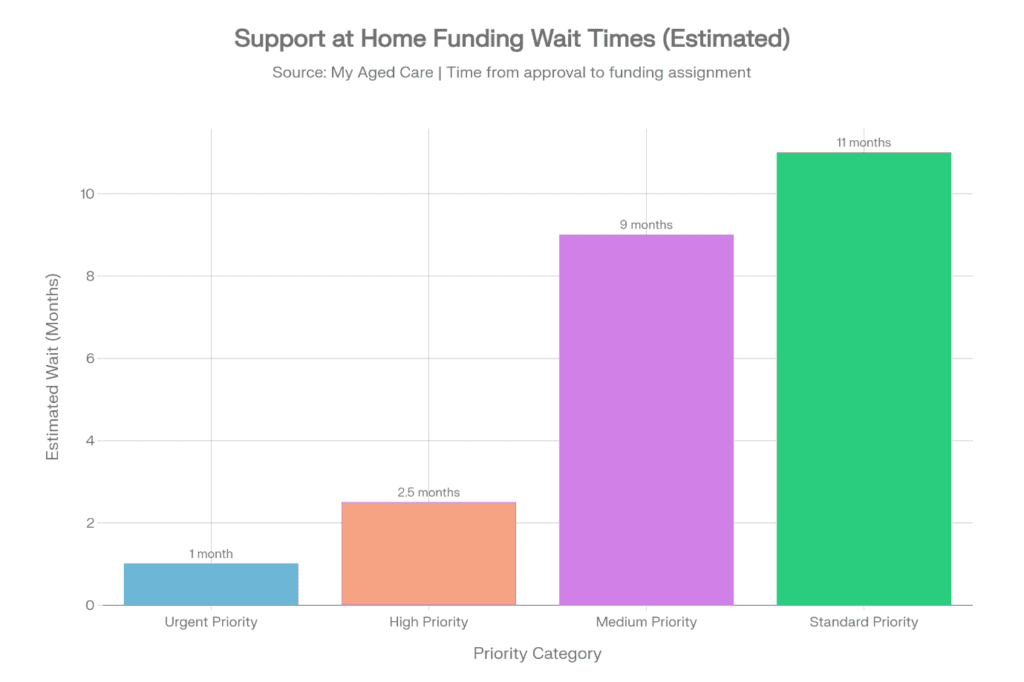
Urgent priority is for those at immediate risk of harm or hospitalisation, with full funding usually released within one month.
If you are placed in a lower priority category, you may wait up to 11 months for your full budget to be released.
While you wait, you will likely be offered interim funding to cover essential daily services immediately.

If you’ve just received your My Aged Care outcome letter, you might be relieved to see you’re approved for Support at Home only to realise there’s no start date for your funding.
You’re not alone. Thousands of Australian families are currently in the “approved but waiting” stage.
The old national queue system has changed. Under the Support at Home program, your wait time now depends on a clearer Priority System designed to get help to those who need it most, faster.
This article discusses how the Support at Home Priority System works, explain each priority category, why you might be waiting, typical waiting times and the specific steps you can take today so you’re ready to act the moment your funding is allocated.
How The Support at Home Priority System Actually Works
If you’re approved for Support at Home, your outcome letter will show a Priority Category of urgent, high, medium or standard. This category determines how soon you’re likely to receive funding.
The Support at Home Priority System replaced the previous Home Care Packages queue on 1 November 2025. While the old system also factored in need (via Package Levels 1–4), the new system makes your priority category the primary driver of how fast funding is released.
What’s different now:
- Old System: Under Home Care Packages, you were queued based on your Package Level (1–4) and your approval date. People waiting for a Level 2 package competed with other Level 2 approvals.
- New System: Under Support at Home, you’re queued based on risk and need first, then approval date. Your Support at Home Classification (1–8) determines how much funding you receive, but your Priority Category determines when you receive it.
In plain terms: Two people approved for the same classification, could have very different wait times. The person with high priority will receive funding before the person with medium priority, even if they applied on the same day.
Your priority is assigned during your assessment and is based on factors like:
- Safety risks at home (falls, unsafe living conditions).
- Whether you have a carer and how well they’re coping.
- Your physical and cognitive health.
- Whether you’re at risk of needing residential care if you don’t get help soon.

Support at Home Priority Categories Explained
Your priority category is determined during your assessment and listed in your outcome letter. Here is what each category generally means for your wait time:
1. Urgent Priority
- Who it’s for: People at immediate risk of harm, hospitalisation, or where a primary carer can no longer cope (e.g., recent fall with no mobility support, sudden carer burnout leading to neglect risk, end-of-life needs requiring instant home palliative care).
- Typical wait: Very short, often funded within 1 month or less.
- Goal: Immediate safety net to prevent residential care entry.
2. High Priority
- Who it’s for: People with significant needs who are struggling to manage alone but aren’t in immediate crisis (e.g., frequent safety hazards at home risking hospital admission, carer exhaustion without breakdown yet, inability to perform daily tasks leading to potential eviction).
- Typical wait: Estimated at 1.5 – 2.5 months.
- Goal: Timely support to stabilise health and independence.
3. Medium Priority
- Who it’s for: People who need regular help with tasks like cleaning, shopping, or personal care but are currently stable. (e.g., gradual decline in memory affecting household management, worsening mobility requiring consistent assistance, current informal supports becoming insufficient long-term).
- Typical wait: Estimated at 8 – 9 months.
- Goal: Scheduled release of funds to maintain independence.
4. Standard Priority
- Who it’s for: People with lower-level needs where care is preventative (e.g., help with heavy gardening or occasional transport carer temporarily unavailable, early signs of independence challenges).
- Typical wait: Estimated at 10 – 11 months.
- Goal: Long-term planning rather than immediate intervention.
Why The Real Wait Can Feel Longer
While the official estimates above provide a guide, many families find the actual wait is longer. This is because these estimates only account for the time after approval.
In reality, the total wait often includes:
- Waiting for assessment: It can take weeks or months to get an ACAT assessment booked.
- Waiting for approval: Processing the outcome letter takes time.
- Local demand: Wait times can vary based on demand in your specific region.
Research from independent bodies like COTA and Anglicare suggests that for many older Australians, the total time from first contact to receiving care can stretch to 12–15 months, especially for those with standard needs.
Why Am I Still Waiting for Support at Home?
If you are in the Medium or Standard category, waiting 6+ months can feel frustrating. It’s important to know that:
- There is still a queue: Within your priority category, funding is released based on your approval date. You are queuing only against people with similar needs, not the whole country.
- Interim Funding: Right now, many new Support at Home approvals are being released as interim funding (60% of your total budget) so you can start essential services while you wait for the remaining 40%. Your letter will explain if this applies to you and when the rest of your budget will become available.
Learn more about Support at Home interim funding.
What To Do If Your Situation Changes
Your priority category is based on a snapshot of your health on the day of your assessment. But health changes.
If your situation deteriorates while you wait, you do not have to stay in the same queue. You can request a priority review (re-classification).
Triggers to request a review:
- A recent fall or hospital admission.
- Carer stress: If your spouse or family member is unwell or can no longer provide the same level of help.
- New diagnosis: Such as dementia or a condition that impacts mobility.
- Loss of support: If a private cleaner or volunteer service stops coming.
How to act:
Contact My Aged Care to update your client record. Be specific about what has changed and the new risks you face. While a review doesn’t guarantee a jump in your priority status to Urgent, it is the official way to signal that your need is now critical.
Don’t Just Wait, Get Contract Ready
One of the biggest risks for families is finally getting their funding letter and then scrambling to find a provider.
Once your funding is allocated, you have 56 days to choose a provider and sign a Service Agreement. If you need more time, you can usually request an extension to 84 days through My Aged Care. If you still don’t sign within that extended period, your funding may be withdrawn and you may need to re-join the waiting list.
Steps to Take While You Wait
- Shortlist 3 Providers: Don’t wait for the money to land. Research local providers now.
- Compare Fees: Ask for their price list and specifically check their Care Management Fees. These can vary hugely and eat into your budget.
- Prepare Your Paperwork: Have your Medicare card, CRN (Customer Reference Number), and any Power of Attorney documents in a folder ready to go.
Or, Let Aged Care Decisions Do The Leg Work For You
We save you time and stress by creating a tailored shortlist of providers who:
- Have current availability in your suburb (no calling providers who are full or don’t service your area).
- Match your specific care needs and budget.
- Are transparent about fees, so you can compare apples with apples.
We don’t just send you a list, we walk you through it. Once you’ve chosen your top picks, we’ll organise meetings with those providers and help you through the process of signing your Service Agreement.
100% free. 100% independent. No obligation.

Here’s how Aged Care Decisions’ FREE aged care matching service works: