Key Takeaways
- Your budget is flexible: You can ask your provider to review your care plan and adjust your mix of services for winter without needing a formal reassessment from My Aged Care.
- Prevent winter falls: Use your home maintenance funding to clear wet leaves from gutters and pressure-wash slippery moss from outdoor pathways before the rain sets in.
- Stay warm and well-fed: Shift your services toward heavy domestic assistance (like changing winter doonas) and arrange for bulk meal preparation or delivery so hot meals are always ready.
- Keep connected indoors: If it’s too wet or cold to go out, transport and social support services can easily be moved indoors to prevent isolation and the winter blues.
Your Support at Home funding can be used to prepare your home for winter, covering everything from clearing gutters and checking heating to extra domestic help and warm meal preparation.
Many families don’t realise that if your needs change, you can ask your provider to review and update your care plan. As the weather cools, a conversation with your provider’s Care Partner is often all it takes to ensure your services are more winter focused before the cold really sets in.
Here is exactly what you can do, and how to get started before the cold sets in.
Why Winter Is a Higher-Risk Season for Older Australians
Winter brings a genuine increase in health and safety risks for older Australians, with seasonal illnesses being the most common cause of deterioration in health. Cold and flu viruses circulate more widely in winter, and for older people, even a mild flu can quickly lead to complications, hospitalisation, or a decline in mobility and independence.
At the same time, winter weather creates additional risks:
- Slips and falls become more likely when wet leaves, moss and damp surfaces build up on paths and driveways.
- Chronic conditions like arthritis, joint pain and respiratory issues often flare up in the cold, making daily tasks harder.
- Social isolation increases when it is too cold and wet to get out, which can quickly lead to the winter blues or clinical depression.
Addressing these risks before winter arrives, rather than after an incident, is one of the most practical things a family can do to ensure their parents stay safe at home.
What Can You Use Your Support at Home Funding for In Winter?
Support at Home funding covers a broad range of services across everyday living, independence and clinical care. In the lead-up to winter, relevant service categories include:
Home Maintenance
Your funding can cover a support worker or tradesperson to:
- Clear gutters of leaves and debris.
- Check that smoke alarms and gas or electric heating systems are working safely.
- Pressure-wash moss or slip hazards off outdoor paths and steps.
These small jobs can prevent major accidents. A slippery front path is one of the leading causes of falls for older Australians.
Domestic Assistance
Seasonal household tasks can be physically demanding and risky. A support worker can:
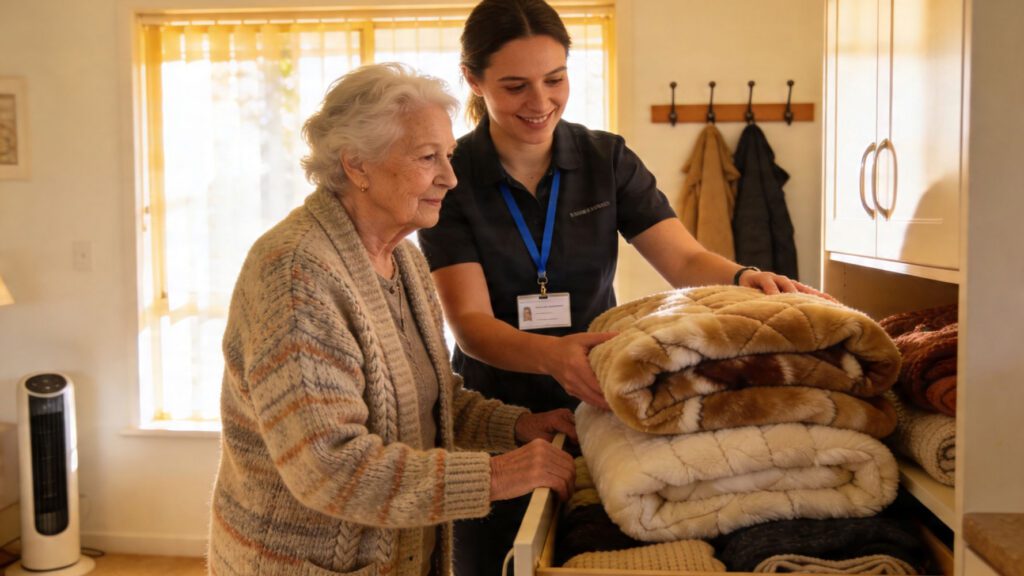
- Retrieve heavy winter coats and blankets from storage and wash and change beds over to warmer winter linen.
- Help manage extra laundry loads that come with colder, wetter weather.
- Take out the rubbish and sweep outdoor pathways to clear wet leaves and debris before they become a slip hazard.
Meal Preparation
It’s easy to assume Mum or Dad is eating well when you’re not there. But in winter, when cooking feels harder and appetite can drop, many older Australians quietly start skipping meals. The good news is that your Support at Home funding covers both meal preparation (where a support worker cooks fresh, warm meals in the home) and meal delivery services (like Meals on Wheels) where pre-prepared meals are delivered directly to the door. This means your loved one can continue to enjoy regular, hot, nourishing food without the added strain.
Staying Healthy With In-Home Clinical and Allied Health Services
Winter is synonymous with cold and flu season. If your loved one is prone to respiratory issues or joint stiffness, you can use the Clinical Care category of your Support at Home budget to bring healthcare directly to their living room.
- In-Home Nursing Care: Instead of sitting in a crowded medical clinic waiting room, a registered nurse can visit your parent at home. They can perform welfare checks, monitor chronic conditions like asthma or COPD and ensure medications are being taken correctly.
- Allied Health (Physiotherapy): When it is too wet or cold for a daily walk, older adults can quickly lose muscle tone and mobility. An in-home physiotherapist or occupational therapist can design a safe, indoor stretching and mobility program to keep their joints moving and prevent physical decline during the colder months.
Read our Support at Home guide for more information.

How Can Support at Home Funding Help with Getting Out In Winter?
Getting out of the house becomes harder in cold, wet weather but isolation is a real health risk. Two service categories can help here.
Transport services allow a support worker to handle grocery runs and pharmacy visits on your loved one’s behalf, so they are not navigating slippery carparks or getting drenched at a bus stop.
Social support visits can easily move indoors. Having a familiar care worker come over for a cup of tea, a chat or to help with an indoor hobby is a fully funded, legitimate service, and a valuable way to prevent loneliness between family visits.
What a Winter-Proof Care Plan Looks Like in Action
To understand how flexible your quarterly budget can be, let’s look at a real-world example of how a family might adjust their services for winter.
Meet Barbara. Barbara has Support at Home Classification 3, which gives her a set quarterly budget to spend on her care.
During the summer, Barbara used her budget for fortnightly lawn mowing and weekly transport to the local shopping centre so she could buy her own groceries.
As May approaches, Barbara’s daughter calls their Care Partner to adjust the plan. Because the grass grows much slower in winter, they pause the fortnightly lawn mowing. They use those freed-up funds to pay for a one-off gutter clean and a safety check on Barbara’s gas heater.
Instead of Barbara going out in the rain, they change her transport service to a domestic assistance service. Now, her support worker does the grocery shopping for her and spends the remaining hour bulk-cooking a warm winter stew.
Barbara stays warm, her budget remains balanced and her daughter has complete peace of mind.
How Do You Adjust Your Support at Home Services For Winter?
Support at Home operates on a quarterly budget system, which means you have a set amount of funding to manage every three months. This makes it incredibly easy to plan ahead.
The simplest step is to call your provider’s Care Partner and ask for a care plan review. In most cases, you can swap services you are using less for winter-focused maintenance and indoor help without needing a formal Support Plan Review from My Aged Care.
If your loved one’s mobility has also changed since last winter, this is a good time to ask whether any assistive technology or home modifications like a shower chair, grab rails or improved outdoor lighting could improve their safety. These can be funded separately but will require an Occupational Therapist assessment and a formal Support Plan Review.
If your current provider is unable to accommodate a flexible seasonal service mix, it is worth knowing you have the right to switch providers without paying any exit fees.
Not Sure Where To Start? We Can Help
Aged Care Decisions offers a 100% free and independent matching service to help families find reliable, responsive home care providers in their local area.
Whether you need a provider who offers flexible home maintenance, proactive clinical care or transport support this winter, our team can match you with trusted, available options near you.
Get our FREE Personalised Options Report today.

Here’s how Aged Care Decisions’ FREE aged care matching service works: