







YOUR FRONT DOOR TO AGED CARE
My Aged Care Guide: How to Access Government-Funded Aged Care
Finding the right aged care support starts with understanding how the system works. My Aged Care is the starting point for accessing government-funded aged care services. This guide explains the registration process, assessments and the steps involved in arranging care.
When you are ready to explore care providers, Aged Care Decisions can help you compare options matched to your needs, location and budget.
Contents
Jump to the section you need
- What is My Aged Care?
- Who Can Access Aged Care?
- The 4 Steps to Access Aged Care
- How to Register with My Aged Care
- The Aged Care Assessment Explained
- Managing My Aged Care Online
- Getting Help from Someone You Trust
- What Happens After You're Approved
- How Aged Care Decisions Can Help
- Frequently Asked Questions
- Articles and Guides
Disclaimer: This page provides general information only and is not personal financial advice.
What is My Aged Care?
My Aged Care is the Australian Government’s central entry point for aged care. Whether you’re after a bit of help around the house, more substantial support to stay living at home or a move into residential care, your journey starts here. My Aged care is the front door to the whole system. You can’t access government-funded aged care without going through My Aged Care first.
Aged care involves several different organisations, each with a different role. My Aged Care is your starting point for registering, arranging an assessment and accessing government-funded support. Assessors take the time to understand your needs and recommend the right level of care. Once approved, providers deliver your services, while the Department of Health, Disability and Ageing manages the broader aged care system.
Understanding how these roles fit together can help you feel more confident about your next steps. You can reach My Aged Care 4 ways:
- online at myagedcare.gov.au,
- by phone on 1800 200 422
- by post
- or in person at a Services Australia service centre.
We cover each option, and when to use which, in how, where and why to contact My Aged Care.
Who Can Access My Aged Care?
Government-funded aged care is based on your needs, as well as your age. You can generally access aged care if you are experiencing difficulties with everyday tasks (like showering, cooking or getting around) and you are:
- 65 or older.
- 50 or older and identify as an Aboriginal or Torres Strait Islander person.
- 50 or older (45 for Aboriginal or Torres Strait Islander people) and are on a low income, homeless or at risk of homelessness.
You don’t need a doctor’s referral to get started. If you’re an older person noticing that daily life is getting harder or you’ve noticed an older family member struggling, that’s reason enough to register and ask for an assessment.
Not sure whether you qualify? Our full My Aged Care eligibility guide walks through the criteria in detail, or you can use the eligibility checker on the My Aged Care website.
The 4 Steps to Access Aged Care
Getting government-funded aged care follows the same four steps for everyone, whether you need a little help at home or full residential care. My Aged Care guides you through each one.
1
Register & Check Eligibility
Contact My Aged Care online or on 1800 200 422 to set up your record and answer a few questions about how you’re managing day to day. This confirms whether you’ll be referred for an assessment.
2
Complete Your Assessment
A trained assessor visits you at home to understand your needs, your goals and the support already around you. There is nothing to pass or fail. It is simply a conversation about what would help you stay safe and independent.
3
Wait for Approval
After your assessment, you will receive an outcome letter explaining what aged care services you have been approved for. For Support at Home, you then wait for funding to be assigned. For residential aged care, you can start applying to aged care homes once approved
4
Choose a Provider & Start
Once you are approved, the next step is to choose a provider. For Support at Home, you have 56 days from funding assignment to enter an agreement. For residential aged care, you apply directly to aged care homes and timing depends on vacancies
How to Register with My Aged Care
Registering is the first real step, and it’s more straightforward than most people expect. You can do it yourself, or someone can do it with you or on your behalf.
Register by phone
Call 1800 200 422, Monday to Friday 8am–8pm and Saturday 10am–2pm (local time). A staff member takes you through a short set of questions over about 10 minutes. This is often the easiest option if you’d rather talk to a person, or if you’re helping an older relative.
Register online
Set up your record through the My Aged Care website. It takes around 15–20 minutes and you’ll answer the same screening questions in your own time. You’ll create or link a myGov account to manage everything afterwards — more on that in managing it online.
Have your Medicare card handy
Whichever way you register, keep your Medicare card nearby. It also helps to have a rough idea of the tasks you find hardest, so the screening reflects your real situation.
Prefer not to use a computer at all? That’s completely fine, our guide to navigating aged care offline shows how to register, request paper forms and organise your aged care by phone post or in person.
The Aged Care Assesment Explained
Before
Booking & Prep
My Aged Care arranges a time for an assessor to visit you at home. Beforehand, gather a few things (see the checklist) and have a think about the tasks you find hardest — it helps to jot them down so nothing slips your mind on the day
During
Home Visit
The assessor visits and talks through your health, mobility, memory, daily routine and the support you already have. This usually happens in your home or current residence, but it can also happen in hospital if needed.
After
Decision & Plan
You’ll receive an outcome letter and support plan explaining what you’ve been approved for. If you’re approved for Support at Home, you may then wait for funding assignment. If you’re approved for residential aged care, you can start looking for and applying to aged care homes.
What to bring
- Medicare card
- A list of your medications and health conditions
- A support person, if you'd like one there
- A few notes on the tasks you find hardest
Describe your worst days, not your best ones. It's natural to want to seem like you're coping but the assessment should reflect your more difficult days so you're approved for the support you actually need.
Managing Your My Aged Care Account
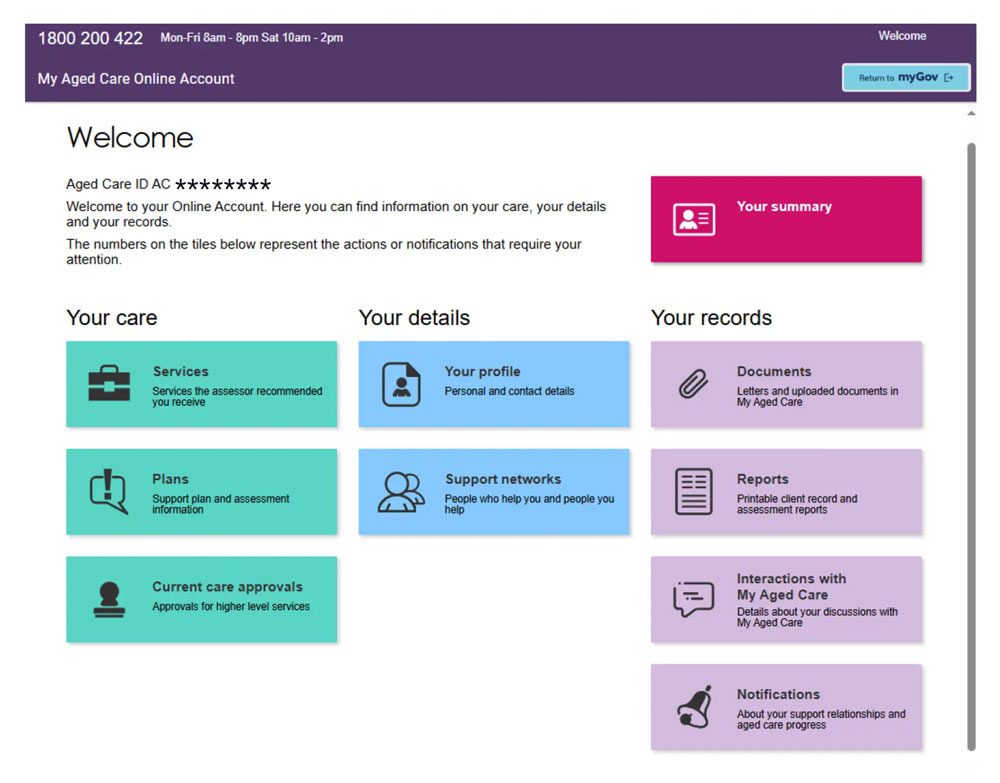
Once you’re registered, you can access your My Aged Care online account via MyGov. This portal becomes your home base for everything that follows.
See Your Plan
View your assessment results and support plan in one place.
Track Progress
Follow your application from registration through to approval.
View Letters
Read every notice and letter My Aged Care sends you.
Manage Services
See and manage the providers and services linked to your record.
New to myGov?
Linking My Aged Care to myGov takes just a few short steps. → Read how to set up your myGov account
Rather not go online?
You can register and apply for My Age Care by phone or inperson → Contact a Services Australia Age Care Specialist Officer
Getting Help From Someone You Trust
Registered Supporter
Register someone you trust so they can speak with My Aged Care, arrange your assessment and manage services alongside you. Even close family must be registered first.
Learn more about: Aged Care Registered Supporter
Appointed Decision-Maker
If the older person cannot give consent (if they have dementia, for example) an appointed decision maker can act on their behalf.
Lear more about: The Enduring Power of Guardianship
Interpreter (TIS)
If English isn't your first language, the Translating and Interpreting Service offers free interpreting. Call them on 131 450 and ask them to call My Aged Care. Lear more about TIS
Speak to a Person
Not comfortable using a computer? You can organise your aged care in persons at certain Services Australia locations or by phone and post. Learn more about: How to Navigate My Aged Care Offline
What Happens After You're Approved?
Your Support Plan tells you the type of care you have been approved for. Choose the option below to understand what it covers and how to get started.
Support at Home
Coordinated services such as personal care, clinical care, meals, transport and help around the home.
Residential Aged Care
Accommodation, meals, personal care and clinical support in an aged care home.
Commonwealth Home Support Program
Entry-level services that can help with daily tasks and staying connected in the community.
How Aged Care Decisions Can Support You
Once you’ve been approved, it’s time to find an Aged Care Provider. There are hundreds to compare and it can be hard to know who has availability. That’s where we come in.
Aged Care Decisions is a FREE, independent service. Tell us about your situation and we’ll match you with providers who suit your needs and have availability, so you can compare real options side by side instead of ringing around. There’s no cost and no obligation.
Frequently Asked Questions
Is My Aged Care free to use?
Yes. Registering, being assessed and using My Aged Care itself costs nothing. You may contribute to the cost of your care once services start, depending on your income and assets, but the gateway and assessment are free. Use My Aged Care Fee Estimator to get an indication of the fees that may apply.
How do I register with My Aged Care?
Call 1800 200 422 or register online at myagedcare.gov.au. Phone registration takes about 10 minutes; online takes 15–20. Have your Medicare card ready. If you’re not online, you can register entirely by phone and post.
Who can register or deal with My Aged Care on my behalf?
Someone you trust can act for you once they’re registered as your Registered Supporter. If you can’t give consent yourself, an Appointed Decision-Maker can be set up. Even immediate family must be registered before My Aged Care can share your information with them.
Can I get aged care if I'm under 65?
Possibly. Aged care is generally for people 65 and over (50 and over for Aboriginal and Torres Strait Islander people), but younger people on a low income or experiencing homelessness may also be eligible. Younger people with disability are usually supported through the NDIS instead.
What's the difference between My Aged Care and my provider?
My Aged Care is the government gateway that registers and assesses you. Your provider is the organisation you choose to deliver your care once you’ve been approved. My Aged Care doesn’t provide care
Do I have to go through My Aged Care to get aged care?
Yes, if you want government-funded aged care. My Aged Care is the single entry point. You register and are assessed here before any funded services can begin. You can always arrange privately paid care outside the system, but funded care runs through My Aged Care.
How long does an aged care assessment take?
The assessment visit itself usually runs one to three hours. How long you wait for the visit, and for a decision afterwards, varies depending on your circumstances and location.
What if I don't have a computer or the internet?
You can do everything by phone on 1800 200 422 and by post — request paper forms and a face-to-face or phone assessment. Our guide to navigating aged care walks through the whole process.
What happens if I'm assessed and don't agree with the outcome?
You can ask for a review of the decision, and you can request a reassessment if your needs change. Your support plan and Notice of Decision explain your options.
Can I choose my own aged care provider?
Yes. Once you are approved for government-funded aged care, you can choose the provider that delivers your services. Your provider must be able to meet all services in your support plan.
Aged Care Decisions can help. Our free, independent service helps you compare local aged care providers based on your needs, location, availability and pricing.
Articles and Guides

Support at Home Lifetime Cap: Fees, Limits and Rules
The Support at Home lifetime cap is designed to put a limit on your total non-clinical care contributions. Once you reach the cap, your co-contributions stop and the Government continues funding your eligible care package.

A Step-By-Step Guide to Completing Form SA456: Support at Home Calculation of Your Cost of Care
The Support at Home Calculation of Your Cost of Care form (SA456) is the form Services Australia uses to assess your income and assets for Support at Home. It determines how much you pay and how much the government subsidises your care. We’ve put together this step-by-step guide to help you complete it.

Aged Care Decisions Featured in National Media Coverage
Aged Care Decisions has recently been featured in national and regional media coverage, highlighting the importance of informed decision-making when navigating aged care.

Is Aged Care Advice Worth the Cost?
Is aged care financial advice worth the cost? Specialist advice may reduce fees, protect pension entitlements and help families make the right choices when it comes to planning aged care.

New Centrelink Asset Test Limits for July 2026
Each 1 July, the government indexes a range of Centrelink thresholds to keep pace with the cost of living. This round focuses on income limits and thresholds, and affects Aged Pension and Aged care costs.

Aged Care Fees for Couples: Home Care vs Residential Care Costs
When one partner moves into residential care is it more cost effective for the partner at home to get Support at Home funding or pay for private care?