The Support at Home lifetime cap is a financial protection that limits your total non-clinical aged care contributions. This limit is indexed twice a year on 20 March and 20 September. Once reached, the Australian Government fully funds your remaining care package and your personal co-contributions stop. This cumulative cap follows you from home care into residential aged care, ensuring all eligible contributions you have already made continue to be recognised.
Key Takeaways
- The Support at Home lifetime cap is indexed in March and September and applies to your total non-clinical care contributions.
- Clinical care support at home services like nursing and physiotherapy are fully funded, so you never pay a co-contribution for these.
- Independence support at home services attract a 5% to 50% contribution, while Everyday Living support at home services attract 17.5% to 80%, based on your means.
- Reaching the cap usually takes many years and typically applies to self-funded retirees receiving significant care.
- Contributions made under Support at Home carry over if you later move into an aged care home.


How the Lifetime Cap Protects You
One of the biggest concerns older Australians have about receiving aged care is simple: Will I lose all my savings?
With the introduction of the Support at Home program, many people have heard they will need to contribute towards more towards the cost of their care. While that can sound worrying, there is an important protection built into the system that is often overlooked, the lifetime cap.
This cap is designed to ensure that no matter how long you need care, there is a limit to how much you can be asked to contribute.
What Are the Three Contribution Rates?
Under Support at Home, you will make a co-contribution depending on your income and assets and the services you receive.
There are three broad categories of services.
Clinical support at home care includes services such as nursing, physiotherapy, occupational therapy and other healthcare services. These are fully funded by the Government, meaning you pay no co-contribution, regardless of your financial circumstances.
Independence services are designed to help you remain living safely and independently at home. They include services such as personal care, showering assistance, mobility support and help managing medications. Based on your means, you can contribute between 5% and 50% of the cost of these services.
Everyday living services include domestic assistance, cleaning, gardening, meal preparation and shopping assistance. These services attract the highest co-contributions because they are not considered direct healthcare services. Depending on your financial circumstances, you can contribute between 17.5% and 80% of the cost.
People receiving the maximum Age Pension pay the minimum contributions while generally speaking self-funded retirees pay the maximum contributions, part pensioners will fall in between.

How Much Is the Cap?
These contributions are not unlimited. Your Support at Home contributions have a lifetime cap which is indexed twice a year. At the time of writing, the lifetime cap is $137,917. Once you reach the cap, you stop making co-contributions towards and the Government continues to fund your package.
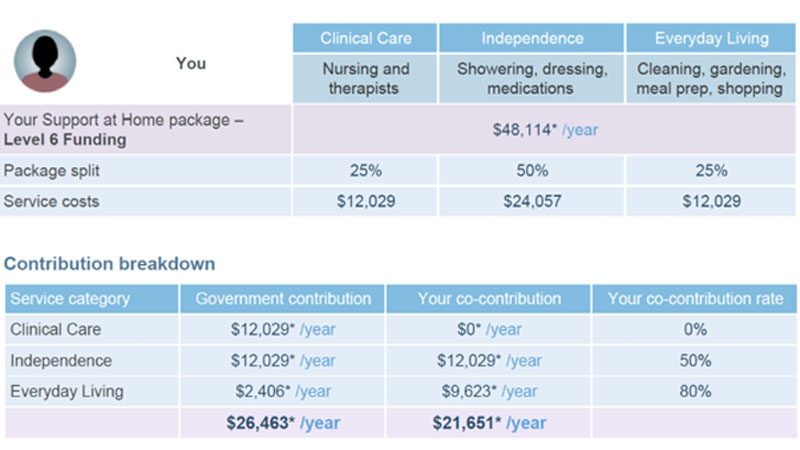
Betty is a self-funded retiree receiving a Level 6 Support at Home package worth $48,114 a year.
Her package is allocated across three service categories:
- Clinical Care: 25% of the package, or $12,029 a year
- Independence: 50% of the package, or $24,057 a year
- Everyday Living: 25% of the package, or $12,029 a year
Based on Betty’s financial circumstances, the Government fully funds her Clinical Care. It contributes $12,029 a year towards Independence services and $2,406 a year towards Everyday Living services.
Betty contributes $12,029 a year towards Independence services, a 50% co-contribution. She contributes $9,623 a year towards Everyday Living services, an 80% co-contribution.
Betty’s total annual contribution is $21,651. At this rate, she would reach the lifetime cap in around six and a half years.
Reaching the cap under Support at Home typically requires you to be a self-funded retiree and receiving significant levels of care over many years. Many older Australians will never reach it but knowing it exists can provide peace of mind.
Does the Cap Follow You Into Residential Care?
It’s also important to know that the cap (and your Support at Home contributions towards it) follow you into residential aged care.
If you later enter an aged care home, any non-clinical care contributions you make count towards your lifetime cap. The system recognises the contributions you’ve already made, so you don’t start again from zero simply because your care needs change.
That doesn’t mean that once your fees in the aged care home reach the cap you stop paying. Only the non-clinical care contribution counts towards the cap. Your accommodation costs, such as a Refundable Accommodation Deposit (RAD) or Daily Accommodation Payment (DAP), the basic daily fee and the hotelling fee still apply after you reach the cap.
See What Support at Home Could Cost You
The lifetime cap is one part of the picture. Understanding how it applies to your situation is what matters most. At Aged Care Decisions, we help you compare and choose Support at Home providers matched to your care needs, location and budget, at no extra cost.
Request your free custom Options Report to see providers with availability that suit you, backed by independent, personalised guidance from first call to service start.
For a limited time, you can also receive the Village Guru Support at Home Costs Report. This shows your likely co-contributions, service split and how long it may take to reach your lifetime cap, based on your own circumstances.
Get your Free Provider Options Report and Support at Home Costs Report today.

FAQs
What Is the Support at Home Lifetime Cap?
The lifetime cap is the maximum total amount you can ever be asked to contribute towards non-clinical Support at Home services. It is currently set at $137,917 and is indexed over time. Once you reach it, the Government covers the full cost of your package going forward.
Do Clinical Care Services Count Towards the Cap?
No, clinical care services such as nursing and physiotherapy are fully funded and never require a co-contribution. Only Independence services and Everyday Living services count towards your lifetime cap. This means the type of care you need affects how quickly you approach the cap.
Who Is Most Likely to Reach the Lifetime Cap?
Self-funded retirees receiving significant levels of care over many years are most likely to reach the cap. Part pensioners fall in between minimum and maximum contribution rates. Many older Australians receiving lower care levels or shorter care periods will never reach it.
Does the Cap Reset if I Move into an Aged Care Home?
No, the cap does not reset when you move into an aged care home. Any contributions you’ve already made under Support at Home carry over, and your non-clinical care contributions in residential care continue counting towards the same cap.
Do I Still Pay Fees After Reaching the Cap in an Aged Care Home?
Yes, reaching the cap only stops your non-clinical care contribution payments. Accommodation costs such as a Refundable Accommodation Deposit or Daily Accommodation Payment, the basic daily fee and the hotelling fee still apply regardless of the cap.
How Are Everyday Living Contributions Different from Independence Services?
Everyday Living services, like cleaning and gardening, attract higher contributions of 17.5% to 80%. Independence services, like personal care and mobility support, attract lower contributions of 5% to 50%, reflecting the difference between healthcare-related and lifestyle support services.
The information contained in this article is intended as general information only and does not constitute personal financial advice, legal advice or professional advice. While care has been taken to ensure the information is accurate and up to date at the time of publication, rules, rates and circumstances can change.
The information provided may not be suitable for your individual circumstances. Before making any decisions about financial matters you should seek advice from an appropriately qualified professional who can consider your personal situation.