

Support at Home Program
The Australian Government launched Support at Home Program in November 2025 to help older Australians live independently in their own homes for longer.
The program uses eight funding classifications to give you better, more targeted help. This guide explains how Support at Home works, and how to get started.
Ready to compare Support at Home providers in your area?

CONTENTS
Jump to the section you need
- What is the Support at Home?
- Support at Home Categories
- Support at Home Classifications & Funding
- Am I Eligible for Support at Home?
- Short Term Pathways
- How Much Does Support at Home Cost?
- Standard Fees & Contributions
- Transitioned Home Care Packages (HCP)
- Grandfathered Fees & Contributions
- How do I Apply for Support at Home?
- Choosing the Right Provider
- FAQs
- Support At Home Guide
- Support At Home Articles New
What is Support at Home?
Support at Home is an Australian Government aged care program that helps older people stay living independently in their own homes for longer.
Launched on 1 November 2025, it replaced the Home Care Packages Program (HCP) and Short-Term Restorative Care Programme, bringing in-home aged care services together into one system.
Eligible participants receive:
Clinical care services
Independence support services
Everyday living assistance (cleaning, gardening, meal preparation)
Funding through eight ongoing classifications or three short-term pathways, based on assessed needs

What Support at Home Program Covers:
The 3 Service Categories
Support at Home Program provides funding for services that help seniors stay safe, healthy and independent in their own homes. The program covers medical care, everyday living assistance and social support, ensuring older Australians can maintain their quality of life while staying connected to their communities.
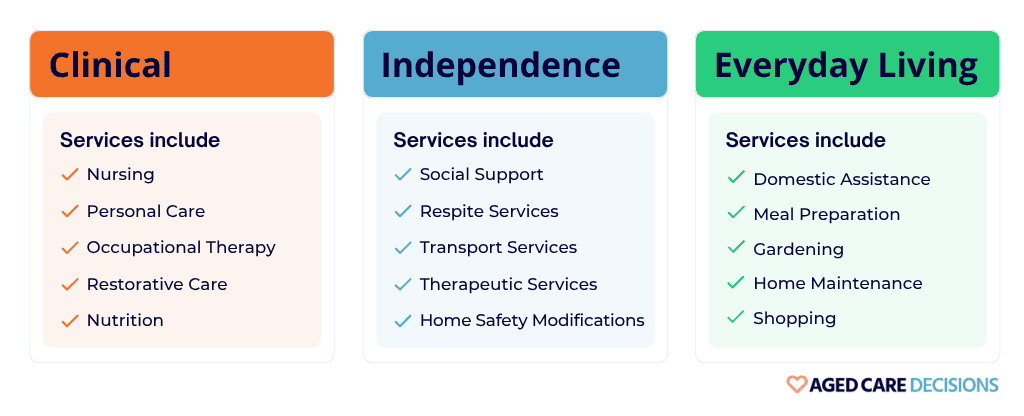
Clinical Care
This category is fully funded by the government and covers essential medical and health services. It includes nursing (like wound care & medication management), allied health services (physiotherapy & occupational therapy) continence support and nutritional management.
Clinical care ensures seniors receive the professional medical support they need to stay healthy at home.
Independence
These services help seniors maintain daily independence and social connections, though some costs may apply. Services include general personal assistance ( like mobility support & eating), social support (group outings & technology assistance), therapeutic services (massage & art therapy), short-term respite care and transport options.
Independence support helps seniors live safely and actively while remaining connected to their communities
Everyday Living
This category covers practical help to keep a home safe and functional. Services include domestic assistance (cleaning, laundry & errands), meal preparation, minor home maintenance, and gardening. It also includes funding for assistive technology (wheelchairs, walking aids & smart home devices) and home modifications (ramps, handrails & accessible bathrooms).
Special programs, like restorative care and end-of-life care, provide extra support for recovery or staying at home in later stages of life.
Support at Home Classifications and Funding Amounts

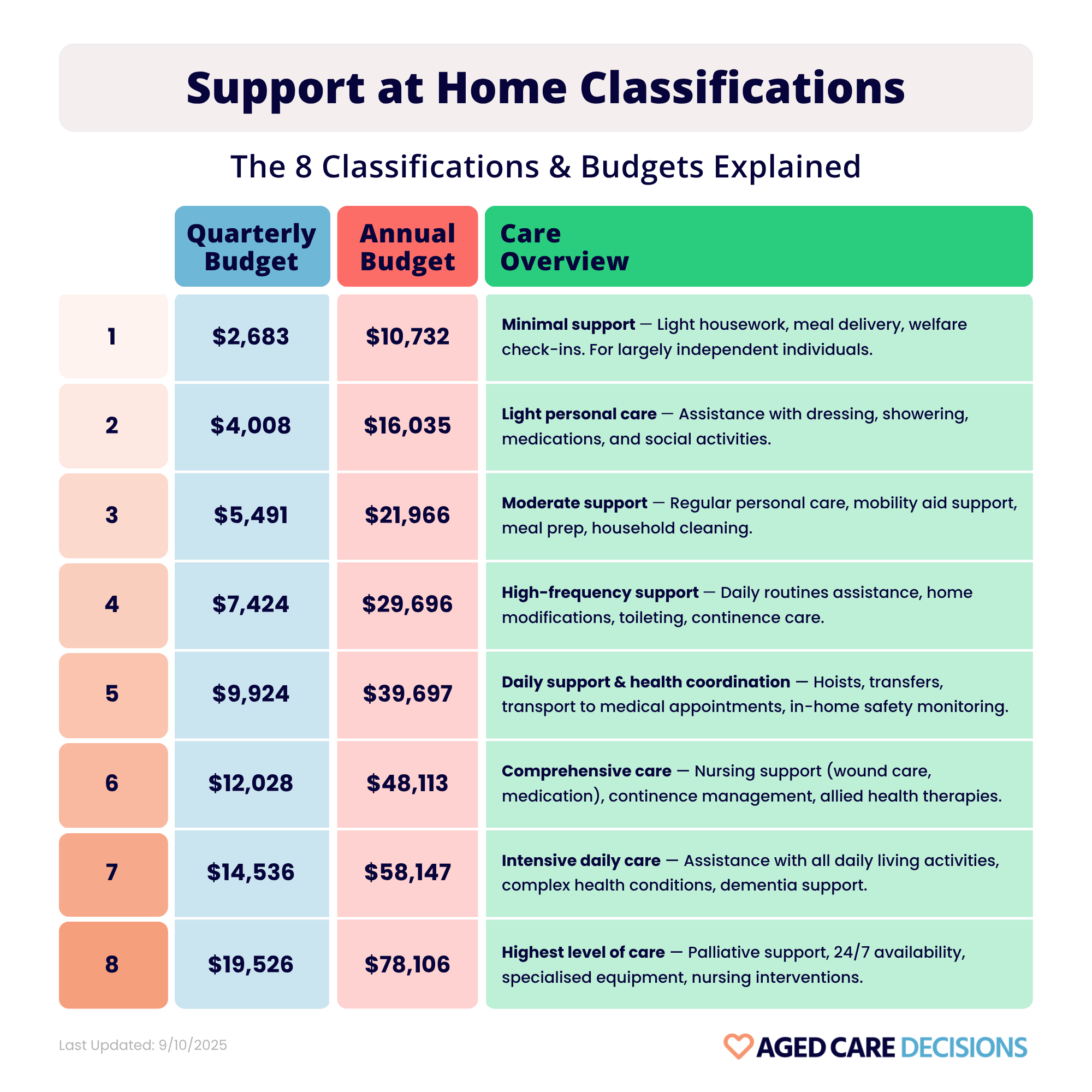
Support at Home uses eight classifications to match your funding to your care needs. Each classification has a set annual amount, divided into four quarterly budgets.
These eight classifications bridge the gap between basic assistance and complex in-home care, ensuring that Australians receive the right type of support at the right time, reducing risks of hospitalisation and premature entry into residential care.You can use your budget to access approved services that suit your circumstances. As your needs change, your support plan and classification can be reviewed and adjusted.
Below, we break down the type of care typically provided at each Support at Home Classification, along with the indicative annual funding amounts. Amounts are indexed and subject to government amendment.
Am I Eligible for Support at Home?
To be eligible for a Support at Home assessment, you generally need to:
- Be aged 65 years or older (or 50 years or older if you’re an Aboriginal or Torres Strait Islander person).
- Have difficulty managing everyday tasks due to age-related factors.
- Require support to remain living independently at home.
These criteria are assessed through a two-part process:
1
Eligibility Check
You can complete an online eligibility check on the My Aged Care website or call My Aged Care at 1800 200 422.
2
In-Person Assessment
If eligible, an assessor will visit your home to evaluate your needs and discuss suitable services.
Learn more about: Support at Home Eligibility.
Support at Home Short-Term Pathways
Restorative Care Pathway
The Restorative Care Pathway helps seniors regain independence with daily activities, supporting them to continue enjoying the things they love and potentially reducing the need for additional services.
Through this program you can:
Access up to 12 weeks of restorative care.
Get an extra budget of around $6,167.33 per episode.
Apply for more funding up to a total of $12,334.66.
Use this care alone or with ongoing Support at Home services.
Assistive Technology & Home Modifications
The Assistive Technology & Home Modifications (AT-HM Scheme) is a dedicated short-term pathway. It helps older Australians get aids, equipment and home modifications. This support is based on your assessed needs.
Through this pathway you can:
Get essential items like walkers or shower chairs.
Organise home adjustments such as handrails or ramps.
Book an occupational therapy assessment to access home modifications.
The End-of-Life Pathway
The End-of-Life Pathway provides urgent support to keep your loved one comfortable at home. You can ask for a high-priority Support Plan Review for fast access. This applies even if you do not receive Support at Home.
Through this program you can:
Get urgent funding if diagnosed with three months to live.
Receive total funding of $25,686.28 over 12 weeks.
Use these funds over a maximum of 16 weeks.
- Ask for an assessment if care is needed beyond 12 weeks.
How Much Does Support at Home Cost?
Your funding and co-contributions depend on when you were first approved for a Home Care Package or Support at Home. Participants generally fall into three groups: grandfathered, transitional and new participants.
The standard fee model applies to people approved on or after 12 September 2024. If you were approved on or before this date, grandfathering rules may protect what you contribute towards your care.
Check our Aged Care Funding and Finances Guide to learn more about the Support at Home costs.
Which Group Are You In?
How to Check Which Group You're In
If you are unsure whether you are grandfathered, transitional or a new participant, you should check:
- The date you were first approved for a Home Care Package or Support at Home.
- Your My Aged Care online account, which shows your approval history and current status.
- Any letters from Services Australia or the Department of Health and Aged Care explaining your contribution arrangements.
You can also call My Aged Care or ask your current provider to confirm which group you fall into and what it means for your contributions and caps.

Support at Home: Standard Fees & Contributions
Approved or Assessed for Home Care Funding AFTER 12 September 2024
Standard Support at Home rules apply to participants who are not covered by the ‘no worse off’ principle. These are people approved for a Home Care Package after 12 September 2024 along with new Support at Home participants who were approved after 1 November 2025.
Clinical care is fully funded by the government for all participants, with no contributions for clinical support services.
Contributions toward Independence and Everyday Living supports are means‑tested. Self‑funded retirees without a Commonwealth Seniors Health Card pay the highest contributions.
Self‑funded retirees who are eligible for a Commonwealth Seniors Health Card have lower contribution rates, similar to part pensioners.
Support at Home Contributions
Service Categories
Clinical
% you pay
Full Pension
0%
Part Pension
0%
Self-funded
0%
Services include
- Nursing
- Personal Care
- Occupational Therapy (OT)
- Restorative Care
- Nutrition
Independence
% you pay
Full Pension
5%
Part Pension
5-50%
Self-funded
50%
Services include
- Respite Services
- Social Support
- Transport Services
- Therapeutic Services
- Home Safety Modifications
Everyday Living
% you pay
Full Pension
17.5%
Part Pension
17.5-80%
Self-funded
80%
Services include
- Domestic Assistance
- Meal Preparation
- Gardening
- Home Maintenance
- Shopping
Support at Home contributions vary by service category and funding source. Clinical services including nursing and therapy are fully government-funded regardless of pension status. Independence services attract 5-50% co-contributions depending on pension status. Everyday Living services have the highest contributions ranging from 17.5-80%, with self-funded retirees paying maximum rates across all non-clinical categories.
Learn more: Support at Home Fees & Contributions Source: Support at Home participant contributions
Transitioned Home Care Packages (HCP)
“Transitioned Level” and “transitional participant” sound similar, but they are two very different things.
Transitional Participants
A transitional participant is someone approved for a Home Care Package after 12 September 2024 but before 1 November 2025.
They are not covered by the ‘no worse off’ principle. They pay standard Support at Home contributions based on their income and assets, unless they get financial hardship assistance.
Transitioned HCP Levels
A Transitioned HCP Level describes your funding, not your fees.
It is a label used to move your existing Home Care Package (HCP) level into the new system with an equivalent quarterly and annual budget.
What This Means For Your Fees
Seeing “Transitioned HCP Level” on your account tells you how much funding you get. It does not tell you what contributions you pay. Your contribution rules depend on when you were approved:
- Approved on or before 12 September 2024: You are grandfathered. You will pay the same or lower contributions under Support at Home. If you didn’t pay an income-tested fee before, you won’t pay contributions now.
- Approved for a Home Care Package after 12 September 2024 but before 1 November 2025: You are not grandfathered. Standard Support at Home contribution rules apply, unless hardship assistance is approved.
Budgets, Unspent Funds and Reviews
Your Transitioned HCP Level provides a quarterly budget. If your needs change, you can request a Support Plan Review to move into one of the eight standard Support at Home classifications.
There are two separate rules for unspent funds:
- Legacy HCP funds: Any unspent funds you built up before Support at Home started carry over in full. You can use these for approved services once your quarterly budget is spent.
- New Support at Home funds: For your new quarterly budget, you can carry over up to $1,000 or 10% of your quarterly budget (whichever is higher) into the next quarter.
Transitioned Home Care Package Classifications
The 4 Classifications & Budgets Explained
| Home Care Packages Classifications | Support at Home Classifications | Quarterly Budget | Annual Budget | Care Overview |
|---|---|---|---|---|
| HCP Level 1 | Transitioned HCP Level 1 | $2,818.04 | $11,272.15 | Basic Needs — Daily tasks such as personal care, light housekeeping, meal preparation, and transportation. |
| HCP Level 2 | Transitioned HCP Level 2 | $4,955.44 | $19,822.76 | Low-Level Care — Assistance with dressing, showering, medications, and social activities. |
| HCP Level 3 | Transitioned HCP Level 3 | $10,787.18 | $43,149.74 | Intermediate Care — Regular personal care, mobility aid support, meal prep, household cleaning. |
| HCP Level 4 | Transitioned HCP Level 4 | $16,353.98 | $65,416.91 | High-level Care — Regular personal care, mobility aid support, meal prep, household cleaning. |
'No Worse Off' Principle
Grandfathered Participants: NWOP
If you were assessed or approved for a Home Care Package on or before 12 September 2024, you will be covered by the ‘no worse off’ principle (NWOP).
The percentage of costs you are asked to contribute will stay the same or be lower:
If you were assessed as not required to pay fees before that date, you will never be asked to pay fees under Support at Home, even if you’re later reassessed to a higher classification.
The $88,934.57 lifetime cap (indexed) remains in place
Your co-contributions may still change if your assessed care needs or financial circumstances change, when indexation applies or once you reach your lifetime cap. Routine indexation occurs on 20 March and 20 September each year.
National Priority System
If you were on the National Priority System awaiting a Home Care Package, you will have been moved to the Support at Home Priority System. Your budget will be allocated once a place becomes available, and it will match your assessed HCP funding. A new assessment is only required if your care needs change.
Service Price Variations
Service prices vary depending on provider, region and other criteria but government protections ensure costs are fair and transparent. Providers will communicate any changes to your in-home care arrangements ahead of time. The Department of Health, Disability and Ageing is working closely with providers to make the transition as smooth as possible and minimise any impact on your care.
Read More: Support at Home price list
Support at Home Grandfathered Contributions
Service Categories
Clinical
% you pay
Full Pension
0%
Part Pension
0%
Self-funded
0%
Services include
- Nursing
- Personal Care
- Occupational Therapy (OT)
- Restorative Care
- Nutrition
Independence
% you pay
Full Pension
0%
Part Pension
0-25%
Self-funded
25%
Services include
- Respite Services
- Social Support
- Transport Services
- Therapeutic Services
- Home Safety Modifications
Everyday Living
% you pay
Full Pension
0%
Part Pension
0-25%
Self-funded
25%
Services include
- Domestic Assistance
- Meal Preparation
- Gardening
- Home Maintenance
- Shopping
Grandfathered participants under Support at Home benefit from protected contribution rates. Full pensioners pay zero % across all service categories, part-pensioners contribute up to 25% for Independence and Everyday Living services only, and self-funded retirees are capped at 25% maximum for non-clinical services.
How do I Apply for
Support at Home?
The Single Assessment System was created to make it easier for older people to access aged care services as their needs change.
If you are not already receiving services through My Aged Care, the first step is to check your eligibility for an assessment. You can do this online at My Aged Care or by calling 1800 200 422.
If your application is successful, you will be referred for an in-person assessment at your home
Once assessed and found eligible for the Support at Home program, you will receive a Notice of Decision along with an individual support plan to share with your provider.
Learn more: How to apply for Support at Home
Learn more: How to choose a Support at Home provider
Your Support At Home Plan Includes:
- A summary of your aged care needs and goals.
- Your classification, along with the associated ongoing quarterly budget and a list of your approved services.
- Any short-term support approvals, which may include funding for:
– Assistive Technology
– Home Modifications
– Restorative Care Pathway
– End-of-Life Pathway
How Aged Care Decisions can support you
Finding the right Support at Home provider doesn’t have to be complicated. Aged Care Decisions (ACD) helps you navigate your options, match your needs with approved providers, and make informed choices with confidence. Start today and take control of your home care journey.
Choosing the Right Support at Home Provider

Understanding your care needs
Our friendly team will ask you a few questions about your individual care needs, location, preferences, and budget so we know how we can assist you in your Support at Home journey.
Unlimited 1 on 1 support
Unlimited 1 on 1 support from your designated Placement Specialist. We provide you with the most up to date Support at Home resources. We assist at every stage of your Support at Home journey.
Customised options list
Receive a customised options list of Support at Home Providers matched to your individual care needs. We match you or your loved one with in-home care services that can provide the in-home care you need.

Aged Care Decisions Assists Thousands of Families Every Month
Shirl B.
“We spoke with ACD yesterday and they were very helpful to clear assisting us to find an alternative home care provider. Nothing was too much trouble and we know that the next provider we choose will be up to the job with well trained staff. Thank you.”
Jeanette W.
“Hardest decision of my life is putting my mum in care. So helpful and understanding of what I wanted for her and sent everything within minutes I asked for. Thank you.”
Andrea S.
“Aged Care Decisions were very helpful in providing Home Care Package providers in my area, and followed up to make sure that the whole process was going well. Highly recommended!”
Frequently Asked Questions
What is the Support at Home program?
A single, government-funded in-home aged-care program that replaces the Home Care Packages (HCP) and Short-Term Restorative Care programs to deliver assessed in-home supports and clinical services.
When does it start and what happens to existing Home Care Packages?
Support at Home commences 1 November 2025. Existing HCP recipients will be transitioned and can discuss the move with their provider; funding equivalence is maintained during transition
How much will I pay for my home care?
Access is via My Aged Care (Single Assessment System). Assessment outcome assigns a classification and an approved support plan; then you choose a registered provider. This mirrors HCP entry steps, but uses the new classification system.
Who is eligible for Support at Home?
To be eligible for Support at Home you must be:
- aged 65 years or over (50 years or older for Aboriginal and Torres Strait Islander people)
- living at home (not in residential aged care)
- an Australian citizen or permanent resident
- assessed by My Aged Care as someone who needs home care services.
You can quickly check if you’re eligible using My Aged Care’s online eligibility checker.
What happens during the Support at Home assessment?
A member of the My Aged Care assessment team, usually a nurse, social worker, or health care professional, will visit you in your home. They’ll look at the way you manage day-to-day activities and speak with you about what aged care services will be best to help you. The assessment usually takes between 1-3 hours.
Read more: How to prepare for an aged care assessment
How long will it take to get home care services?
Wait times are generally between 3-6 months but can be as long as 12 months, depending on national demand. You can check the progress of your application or assessment by calling My Aged Care on 1800 200 422 or by logging into your My Aged Care online account.
Learn more: Support at Home wait times
What services can be funded?
Support at Home uses a defined service list across Clinical Supports, Independence, and Everyday Living (examples: nursing, allied health, personal care, domestic assistance, transport, home modifications). Clinical services are explicitly listed as fundable.
Learn more: Support at Home Service List
How are levels and funding structured under Support at Home?
There are 8 ongoing classifications. Each classification has a defined quarterly budget aligned to assessed needs (replacing the HCP four-level model).
Can I buy big ticket items with my Support at Home budget?
Yes. You can use your budget to pay for bigger items like home modifications or a mobility scooter. Your home care provider will work with you to make sure your budget covers what you need. You can also carry over up to $1,000 or 10% of your allocation (whichever is greater) from one quarter to the next.
What will participants have to pay?
Participants will make contributions for Independence and Everyday Living services; clinical services are not subject to participant contributions. The program includes rules on contribution rates, a lifetime cap, no-worse-off protections and financial hardship support.
How much will I pay for my home care?
Support at Home will divide services into three categories, each with different out-of-pocket costs.
- Clinical care: the government will cover 100% of the cost of nursing and allied health services.
- Independence: you will pay between 5%-50% of the cost of personal care, social support services and home modifications.
- Daily living: you will pay between 17.5%-80% for domestic assistance, meal preparation and help with shopping.
Please note: The percentage you’ll pay for Independence and Daily Living service categories will depend on your financial status — whether you receive a full pension, a part pension, or are self-funded. In addition, Each provider sets their own price for services.
Read more: Understanding contributions for the new Support at Home program
Is Support at Home means tested?
Yes. Support at Home is means tested, but only for certain types of services.
Under Australia’s Support at Home Program, an income and assets assessment is used to determine whether you need to contribute to the cost of non-clinical supports.
What the means test applies to
- Independence support services
- Everyday living support services
Your contribution depends on your assessed financial position and the service type. If you choose not to complete a financial assessment, you pay the maximum contribution rate for these services.
What the means test does not apply to
- Clinical care services, which are fully government funded
- Care assessments and care planning
The means test affects how much you pay, not whether you can access Support at Home. Eligibility is based on care needs, while contributions are based on income and assets.
What happens if my care needs change?
Your home care needs will naturally evolve over time. As they do, your home care provider should work with you evaluate and adjust the combination of services you receive. If your care needs increase significantly your My Aged Care assessor may increase your Support at Home classification so you can receive more funding.
What happens if I already have a Home Care Package?
If you have a Home Care Package you will automatically transfer to the Support at Home program on 1 November 2025. You will not need a new assessment unless your needs have changed, and you wish to apply for increased support.
The funding you receive as part of your Home Care Package will remain the same. Any unspent Home Care Package budget will carry over to your Support at Home account.
Your current provider will continue to deliver care under the new program, and you should not experience a “gap” in services.
When will CHSP transition to Support at Home?
The Commonwealth Home Support Program will merge with Support at Home no earlier than 1 July 2027. Until then, there will be no changes to the way your home care services are funded and delivered.
Read more: What is CHSP | The Commonwealth Home Support Program
What happens if I’m on the waiting list for a Home Care package?
If you’ve been assessed for a Home Care Package and are on the National Priority System (waiting list) before 1 November 2025, you will join Support at Home when a place becomes available.
Your Support at Home budget will match the budget of the Home Care Package level you were approved for. You will not need to have a new assessment to get Support at Home.
How can I get urgent homecare support if I need it?
If you’re waiting for Support at Home but need urgent care, your application may be fast-tracked. Contact My Aged Care on 1800 200 422 to find out whether this option applies to your circumstances.
You can also apply to access temporary services through the Commonwealth Home Support Program. Alternatively, you can pay (out of pocket) for private care or ask your GP to connect you with community supports and volunteer organisations in your area.
What happens to my Support at Home budget if I go to hospital, or on holidays?
If you are in hospital or on holidays your Support at Home funds will still accumulate, but your services will pause. You won’t pay for services, but you will still pay the administration fee to your provider while you are away from home. If you need to pause services for more than 28 days your subsidy may be reduced.
How long can I get Support at Home?
You can receive Support at Home for as long as you need it. You don’t need to renew your application each year. It continues automatically. If you move into residential aged care, your Support at Home payments will cease, and your My Aged Care assessor will assist with your transition. You can cancel your Support at Home payments by advising My Aged Care that you no longer need home care services.
Can my spouse and I get Support at Home at the same time?
Yes. If you and your spouse live together and both need home care services, you can be assessed individually, and each receive your own care plan and Support at Home allocation.
You can pool your resources when your care needs overlap. For example, if you are both assessed as needing assistance with housework, your Support at Home budgets can share the cost of a cleaning service.
Can I self-manage my Support at Home package?
Yes, but how you self-manage your home care will change. The Support at Home program will require self-managed home care recipients to follow different rules, apply more structure to care coordination and accept more provider involvement than under the current Home Care Package program.
Read more: How will Support at Home affect self-managed home care?
What governs the Support at Home program?
The Support at Home program is governed by the Aged Care Act 2024, which comes into effect on 1 November 2025. This new law replaces the previous aged care legislation and sets out how care should be delivered, who can provide it, and what rights older Australians have when receiving support at home.
The Act is supported by a set of Aged Care Rules, which explain how services must be managed day to day. These rules cover things like how providers are registered, how funding is used, and what standards of care must be met. While the final details are still being confirmed, they’ll be in place before the program begins.
To help with the transition from existing programs like Home Care Packages, the government has also introduced transitional legislation. This ensures that anyone already receiving care will continue to get the support they need under the new system.
The program is managed by the Department of Health, Disability and Ageing, and all providers are monitored by the Aged Care Quality and Safety Commission. This helps make sure services are safe, reliable, and meet national care standards.
This new governance model is designed to make aged care simpler, more consistent, and easier to trust, so people can feel confident about the support they’re receiving at home.
Can I change providers if I’m unhappy?
If you’re not feeling happy with your current provider, you do have the option to change. But often, the best place to start is with a simple conversation — sometimes once they know what’s not working, things can be sorted out.
If you’ve already had that chat and still feel you want to change, you’re free to look at other providers. There are no exit fees, and any unspent funds in your Support at Home budget come with you. Your new provider can start coordinating your services straight away, so there’s no gap in your support.
At the end of the day, it’s about making sure your care feels right for you.
Read more: How to change your Support at Home provider – at no extra cost
Aged Care Decisions can help you find and compare Home Care Package Providers, with less stress, less running around and at ZERO cost to you.
We regularly share the most up-to-date home care news and information with our families. We can help you to understand exactly how home care is changing and how the changes will affect you.
Our home care support service is 100% free, independent and obligation-free.
How is Support at Home allocated?
Support at Home funding is allocated based on your assessed care needs, not your income or assets.
The process starts with an aged care assessment arranged through My Aged Care. During this assessment, an approved assessor looks at how well you can manage daily activities, your health and mobility, and the level of support you need to continue living safely at home. This assessment determines whether you are eligible for Support at Home and the level of support you require.
Once your needs are confirmed, you are approved for a Support at Home classification. This classification sets the amount of funding available to you, with higher funding provided where care needs are more complex or ongoing. Funding is not issued as cash. Instead, it is provided as an individual budget that can be used to access approved services.
Your budget is allocated across specific service areas, such as clinical care, independence support, and everyday living support. The funding can only be used for services that match your approved needs and service categories. Where required, your personal contribution is added to the government funding to form the total budget available for your care.
Support at Home funding is not fixed for life. If your circumstances change, your needs can be reassessed and your funding adjusted to reflect any increase or decrease in the level of care required.

Support at Home Articles

Sandwich Generation Caregiving: Caring for an Ageing Parent from Another City or State
Sandwich generation caregiving from another city or state can be managed with the right plan. Learn how to arrange care, compare providers and stay involved remotely.

Why Did My Support at Home Contribution Rates Suddenly Change?
Support at Home contributions are changeable. Discover how deeming rates, asset values and personal care rules influence your costs, plus what to check if your fees suddenly look different.

Care for Ageing Parents: How to Start Arranging Aged Care Support
Care for ageing parents starts with a free My Aged Care assessment. Talk with your parent first about the help they’d like, then apply online together or call 1800 200 422. Ask to be listed as their registered supporter so assessors and providers can speak with you.

National Carers Week: Make the Care You Give Visible in an Aged Care Assessment
National Carers Week recognises the care you give. Learn how to explain your caring role, prepare for an aged care assessment and identify support for you and your loved one.

Centrelink Support for the Sandwich Generation: Payments and Help for Family Carers
Balancing care for older parents and your kids or grandkids? You may be eligible for a carer payment or carer allowance.

Support At Home Personal Care Fees: What Has Changed Since 1 October 2026
Did you know? Personal care has moved to Clinical Supports, making it fully funded. Discover what has changed, what stays the same, and what to check on your statement.